
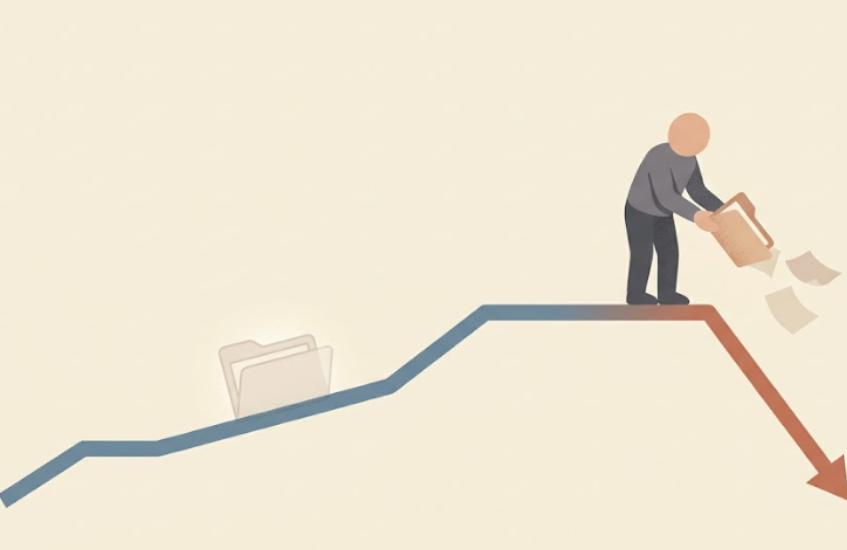
What a Fund’s First Down Round Actually Teaches You About Process
- Sahil Harwani
- September 21, 2026
- Blog
- 0 Comments
Almost every fund eventually has a company raise money again at a lower valuation than before – a “down round” – or fail to raise at all. That’s just how startup investing works, not a sign anyone did anything wrong. What actually helps in that moment is being able to look back at your own reasoning clearly. And keeping that kind of record, on your own, while running everything else a fund needs, is genuinely a lot to ask. It’s exactly why we built the memo structure into CompeteWiser.
A fund manager told us about the week her fund had its first down round. The markdown itself didn’t rattle her – she knew, going in, that this was part of the business. What caught her off guard was the investor call afterward, when she was asked to walk through the original thinking behind the deal, and found herself reaching for details that weren’t fully there anymore. The teammate who’d led the deal had since moved on. The memo existed, but it leaned more on numbers than on the reasoning behind them.
“I knew a down round would happen eventually,” she said. “I didn’t expect it to show me how much of our thinking lived in people’s heads instead of on paper – and honestly, when would we have had time to fix that?”
Why this is so common – and so understandable
Startup investing has a wide range of outcomes, even when the underlying decision was sound. Nearly every fund experiences a down round eventually. It’s not a signal that something was missed – it’s just the nature of backing early, uncertain companies.
What actually helps in that moment is being able to trace back your own reasoning clearly. And here’s the honest part: nobody has time to double-check their notes on a company that’s doing well. There’s no reason to – the good news speaks for itself. It’s only once something underperforms that anyone goes looking for the paper trail, and by then, whether that trail is there often comes down to timing, not effort.
We think that’s a completely reasonable thing to have happen, given how much a small team is juggling. It’s also exactly the kind of gap that’s simple to close once you know it’s coming.
What helps, going forward
- Writing down the actual reasoning behind an investment – the assumptions it depended on – not just the outcome or the amount.
- Keeping that reasoning somewhere lasting, so it’s still there even after the person who wrote it has moved on.
- When a markdown happens, looking back at which specific assumption changed, rather than just noting the number dropped.
- Doing this review as a normal habit, not only when an investor asks – so it never has to happen under pressure.
How CompeteWiser helps
This is exactly what we built the memo structure in CompeteWiser to protect. Every investment write-up follows the same format and captures the real reasoning behind it – not just a summary – and it stays with the fund permanently, even as the team changes. When a down round happens, you’ll be able to walk investors through exactly what you believed, why, and what shifted – calmly, with the details already there, instead of trying to piece it together under pressure.
Want to see what a clear, lasting investment write-up actually looks like? Email us at sahil@theprodzen.com