
Not Every Domino Falls: Which SaaS Companies Are Actually Safe from AI Bundling
- Sahil Harwani
- March 12, 2026
- Blog
- #AI, #AIDisruption, #ArtificialIntelligence, #B2BSoftware, #FutureOfSoftware, #Product Management, #productmanagement, #Prodzen, #SaaS, #StartupStrategy, #TechStrategy
- 0 Comments
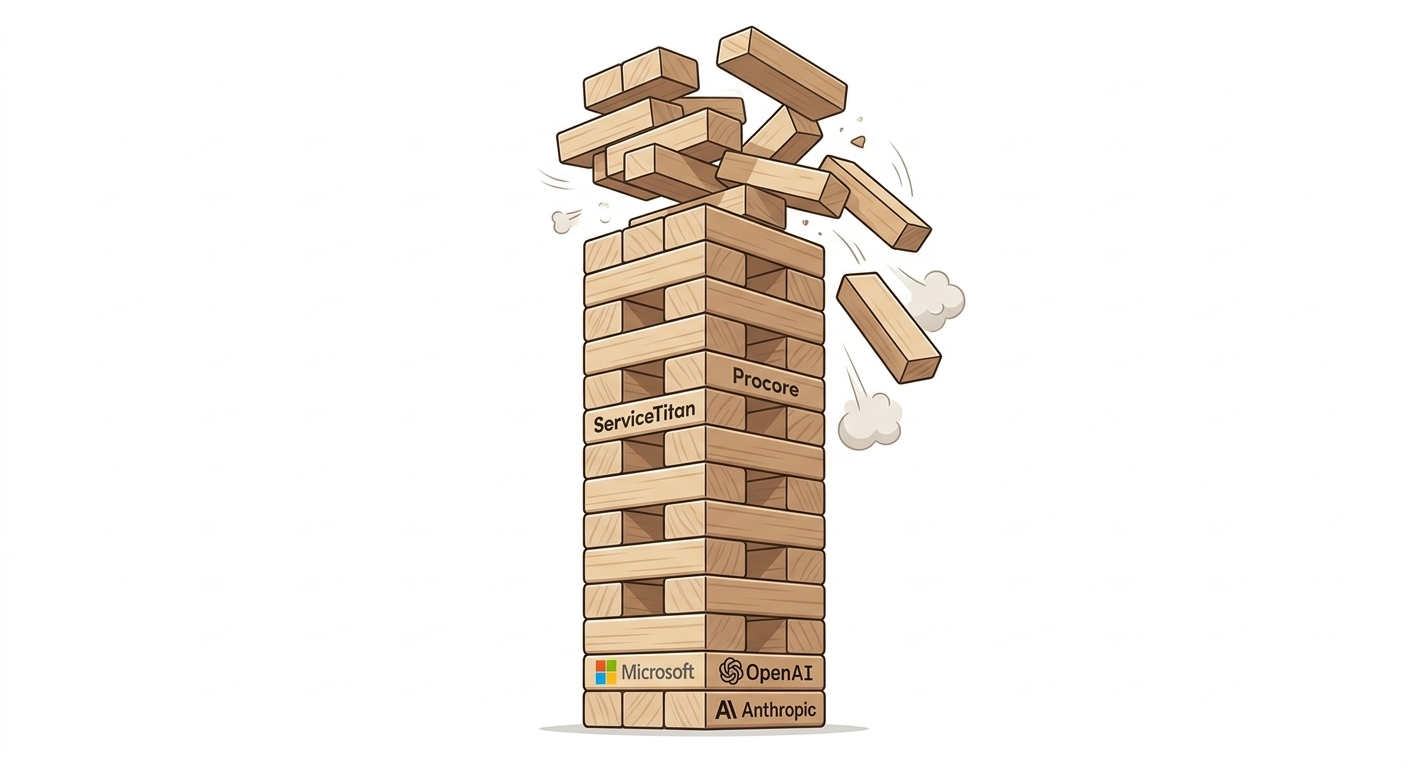
Lately, it feels like the entire SaaS ecosystem is playing a giant, stressful game of Jenga.
The pattern is pretty familiar now. Microsoft adds a feature to Teams , someone’s million-dollar product just became a footnote in a changelog. OpenAI drops a ‘prototype’ on a Tuesday, a founder who just closed a round is on the phone with their investors by Wednesday. Anthropic releases Claude CoWork with plugins of sales and marketing workflows.
The conventional wisdom right now is that “AI wraps” are dead. If your product is just a thin UI layer over a Large Language Model (LLM), you’re toast. The platform giants (Microsoft, Google, Anthropic, OpenAI themselves) are just going to bundle that feature and move on.
But here is the thing about dominos: they only fall if they are lined up perfectly. If they are standing on different ground, they stay upright.
I’ve been thinking a lot about which SaaS companies actually sleep well at night despite the AI panic. They don’t have a magic forcefield, but they have structural moats that are really hard for a giant to bundle away.
Here are the three types of companies that are actually safe.
1. The “Boring” Vertical Kings
If you are building a horizontal tool (like “AI note-taker for everyone”), you are directly in Microsoft’s firing line. But if you are building software for asphalt contractors, dental labs, or industrial waste management, the giants aren’t coming for you.
Why? Because the data model is a nightmare.
Microsoft is never going to build software for asphalt contractors. To do that properly, you’d need to understand things like the difference between HMA, hot mix asphalt, the standard stuff paved at high heat and warm mix, which uses lower temperatures and different chemical additives. Same road. Completely different rules. That’s one detail, in one industry, that serves maybe a few thousand businesses nationwide. Microsoft needs millions of customers to justify building anything. So they don’t. And the small software company that does understand HMA vs warm mix? It owns that market completely, with no giant ever coming to compete.
Companies like ServiceTitan (which builds software for plumbing, HVAC, and electrical businesses) or Procore (which serves the construction industry) aren’t just fancy CRMs with an AI badge slapped on. They’re where the actual work lives. Scheduling, invoicing, inventory, compliance, all of it runs through them. AI can make that scheduling smarter, sure. But it can’t replace the fact that these platforms are where the industry’s data lives. You don’t rip that out. You build on top of it.
2. The Workflow Glue (That Isn’t Just Chat)
There is a lot of panic right now among “AI meeting bots.” But there is a difference between a bot that transcribes a meeting and a bot that does something with that data afterwards.
If your SaaS is simply a better interface for writing or summarizing, you might be in trouble. But if your software sits in the middle of a complex workflow, connecting five different tools and moving data between them, you are much stickier.
Think about companies like Zapier or Make. They are the ultimate glue. Even if Anthropic adds a “Write an email” button to Claude, they haven’t replaced the need to connect Word to your CRM to your Slack to your invoicing software. The argument is that AI might actually increase the demand for this glue, because we’ll need more automation to handle all the new content being generated.
3. The Proprietary Data Fortresses
This is the most obvious one, but we have to talk about it. AI models are trained on the public internet. If your SaaS generates data that isn’t on the public internet, you have a gold mine.
Consider GitHub Copilot, not as a proven killer of coding tutorials, but as the clearest illustration of how this works. Microsoft owns GitHub. GitHub has all the code. So when Microsoft built an AI coding tool, they already had the training data sitting in their own backyard. That’s the pattern. The data came first. The AI product followed. That’s what a real data moat looks like.
Now look at Figma. The whiteboard version, FigJam, is honestly fine but not special. Microsoft and Miro can copy sticky notes. But Figma’s core product is a different story. Million designers have spent years building component libraries, leaving comments, iterating on files, and working in teams inside Figma. That history is the product. A generic AI can copy the canvas. It can’t copy years of how real product teams actually work.
Two examples worth watching. Ramp is sitting on a mountain of real-time business spend data, they aren’t just a corporate card, they’re a financial intelligence engine. GitLab owns the entire DevSecOps lifecycle. The data on how code moves from commit to deploy is immensely valuable and nearly impossible to replicate.
The “Falling Domino” vs. The “Pivot Point”
So, who is actually in trouble? The “Feature-ettes.” The apps that exist purely to solve one tiny annoyance that the big boys just haven’t gotten around to fixing yet.
But the ones who survive? They are the ones who realize that AI is just a new layer of infrastructure. It’s like when the internet happened. It didn’t kill software; it just changed what software looked like.
The companies that are safe aren’t the ones trying to compete with Claude and ChatGPT on a feature-by-feature basis. They are the ones sitting in the middle of a messy, specific, complex human process, whether that is pouring concrete or closing a business loan and using AI to make that process bearable.
The dominos that fall are the ones in a straight line. The ones that survive are the ones building a circle around their customers.