
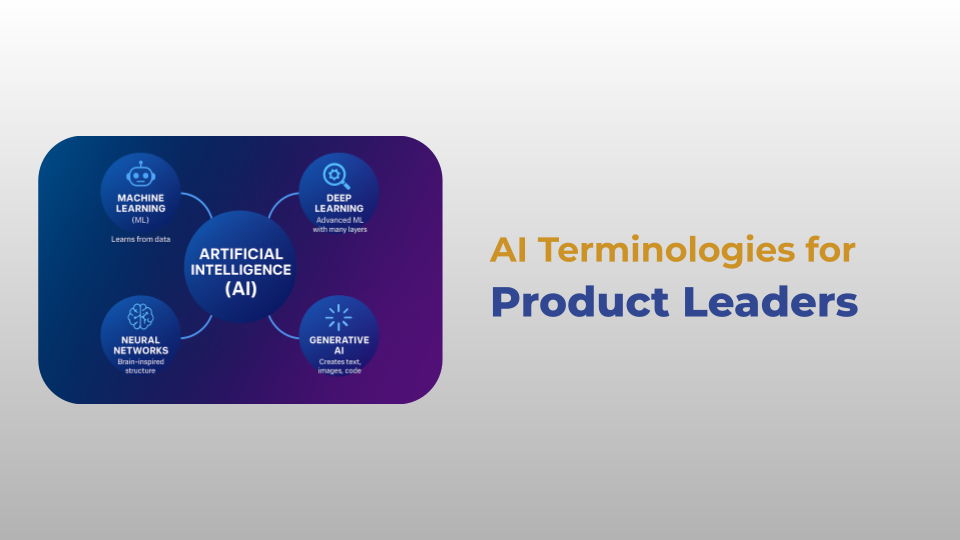
AI Terminologies for Product Leaders
- Sahil Harwani
- April 14, 2025
- Blog
- #AIExplained, #AIforProductLeaders, #AIProductManager, #ArtificialIntelligence, #productmanagement, #productstrategy, #TechForBusiness
- 0 Comments
Explore essential AI terms, concepts, and applications tailored for product management. This page is designed to help you understand and integrate AI into your product strategies.
Introduction to AI Terminologies
AI is reshaping how products are built and managed. As a product leader, understanding AI concepts is essential to leveraging its potential effectively. In this section, we’ll break down important AI terms to help you navigate this transformative technology.
What is Artificial Intelligence?
Artificial Intelligence allows machines to carry out functions that usually demand human intelligence, including comprehending language, identifying images, and making choices. Certain AI systems operate based on set rules, whereas others analyze data, learn from it, and enhance their performance gradually.
Why does it matter?
AI makes tasks easier, faster, and more efficient. It helps in solving problems, automating work, and improving decision-making in many areas.
Analogy
AI is like an intern that keeps learning from experience. At first, it needs guidance, but over time, it improves and starts making decisions on its own.
What is Machine Learning?
Machine Learning (ML) is a subset of AI that allows computers to learn from data rather than relying solely on predefined instructions. By analyzing patterns within the data, ML systems can make predictions and improve their performance over time through experience.
Why does it matter?
Machine Learning (ML) enhances decision-making, automates processes, and boosts accuracy across diverse industries. It is used in areas like healthcare, finance, corporate operations, and everyday applications to analyze data, detect trends, and provide valuable insights.
Analogy
ML is like a chef learning a recipe, after making a dish multiple times, the chef adjusts ingredients to make it better without needing step-by-step instructions.
What is Deep Learning?
Deep learning is an advanced form of machine learning that emulates the way the human brain interprets information. It uses multiple layers of processing, with each layer refining the data to identify intricate patterns similar to how a series of filters can progressively enhance an image.
Why does it matter?
Deep learning allows machines to do complex tasks like understanding speech, recognizing images, translating languages, and powering self-driving cars. It’s key to many modern AI advancements.
Analogy
Deep learning is like a child learning to recognize animals; after seeing many examples, the child understands differences without needing explicit instructions.
What is Generative AI?
Generative AI produces new content like text, images, videos, and music by learning patterns from vast datasets. Unlike traditional AI, which focuses on analyzing or classifying data, generative models create original outputs based on the information they’ve been trained on.
Why does it matter?
Generative AI is revolutionizing industries by driving creative automation, boosting productivity, and delivering personalized user experiences.
Analogy
Generative AI is like a sculptor or potter; after practicing on various materials and techniques, they can shape raw clay into unique, creative forms based on their prior training.
What is Neural Networks?
Neural networks are AI systems designed to learn patterns from data by processing it through multiple layers. Each layer refines the information, allowing the network to perform tasks such as recognizing images, translating languages, and making predictions.
Why does it matter?
Neural networks drive numerous AI applications that boost efficiency, automate processes, and improve decision-making capabilities.
Analogy
A neural network is like a team of detectives solving a case, each detective (neuron) gathers clues, shares findings, and collectively reaches a conclusion.
What are Parameters?
Parameters are the internal values in an AI model that change as it learns from data. They help the model recognize patterns, make predictions, and improve accuracy over time.
Why does it matter?
Parameters define how effectively an AI model carries out tasks such as speech recognition, image processing, and decision-making. When properly adjusted, these parameters enhance accuracy, efficiency, and adaptability, making the model more effective across different applications.
Analogy
Parameters are like the settings on a music equalizer; by adjusting them, you can fine-tune the sound (or AI’s performance) to get the best results.
What are Large Language Models?
LLMs are AI models trained on vast amounts of text data to understand and generate human-like responses.
Why does it matter?
Large Language Models (LLMs) are revolutionizing our interaction with technology by enabling advanced natural language understanding and generation. They drive virtual assistants, automate content creation, improve search engine capabilities, and facilitate real-time language translation.
Analogy
An LLM is like a well-read librarian, it has read millions of books and can quickly summarize, answer questions, or generate new content based on its knowledge.
What are Small Language Models?
SLMs are scaled-down versions of LLMs with fewer parameters, designed for specialized tasks with lower computational requirements.
Why does it matter?
Small Language Models (SLMs) allow AI to operate efficiently on personal devices, minimizing the need for cloud computing. They improve speed, privacy, and accessibility, making AI-driven features such as voice assistants, text predictions, and real-time translations faster, more responsive, and cost-effective.
Analogy
An SLM is like a pocket dictionary, while it doesn’t have the depth of an encyclopedia, it provides quick and useful information for specific needs.
What is Hallucination?
Hallucination occurs when an AI system generates false or misleading information while presenting it as fact.
Why does it matter?
AI hallucination can result in misinformation, unreliable insights, and flawed decision-making. Identifying and addressing these hallucinations is essential to ensure that AI-generated content remains accurate, trustworthy, and safe for practical use.
Analogy
AI hallucination is like a confident storyteller making up facts, it sounds convincing but isn’t always accurate.
What is Prompt?
A prompt is the input or instruction given to an AI system to guide its response.
Why does it matter?
Well-designed prompts enable AI to produce accurate, meaningful, and contextually appropriate responses. They improve the performance of AI in applications such as chatbots, content creation, and decision support, leading to more effective and satisfying user experiences.
Analogy
A prompt is like giving instructions to a barista, if you ask for ‘coffee,’ you might get anything, but if you specify ‘a medium latte with oat milk,’ you get exactly what you want.
What are AI Models?
AI models learn from data to recognize patterns and make decisions. They improve over time using techniques like supervised, unsupervised, and reinforcement learning. However, training and fine-tuning AI models require significant data, computing power, and costs.
Examples of AI Models: GPT-4 (ChatGPT) – Language generation, DALL·E – Image generation
Why does it matter?
AI models drive automation, enhance decision-making, and enable personalized experiences in areas like virtual assistants, medical diagnosis, financial forecasting, and self-driving cars.
Analogy
AI models are like Formula 1 race cars, powerful, but expensive to build, train, and fine-tune. Just as an F1 car requires advanced engineering, continuous testing, and high-performance fuel to stay competitive.
What is Supervised Learning?
Supervised learning is a machine learning method where models are trained on labeled datasets. Each example in the data consists of an input paired with the correct output, enabling the model to identify patterns and make precise predictions.
Why does it matter?
Supervised learning allows AI systems to make accurate predictions and classifications, making it vital for applications such as speech recognition, medical diagnosis, spam detection, and quality control in manufacturing. By learning from labeled real-world examples, it ensures AI improves its precision and reliability over time.
Analogy
Supervised learning is like a teacher grading assignment, students learn from feedback, improving their performance based on correct and incorrect answers.
What is Unsupervised Learning?
Unsupervised learning is a machine learning method where models analyze data without labeled examples to find hidden patterns and relationships. Instead of being given predefined categories, the model identifies similarities and organizes the data accordingly.
Why does it matter?
Unsupervised learning allows AI to discover hidden patterns and structures within data, making it useful for tasks such as customer segmentation, recommendation systems, fraud detection, and genome analysis. It empowers organizations to make data-driven decisions without relying on labeled datasets.
Analogy
Unsupervised learning is like sorting a box of mixed puzzle pieces without the final picture; over time, patterns emerge, helping to group similar pieces together.
What is Reinforcement Learning?
Reinforcement Learning (RL) is a type of machine learning where an AI system learns by interacting with its environment. It makes decisions, receives feedback in the form of rewards or penalties, and adjusts its actions to improve performance over time. The goal is to maximize the total reward through trial and error.
Why does it matter?
RL is widely used in robotics, game AI, recommendation systems, and autonomous systems, helping machines adapt and optimize performance in dynamic environments.
Analogy
Reinforcement Learning is like training a pet; when it performs a trick correctly, it gets a treat (reward), but if it makes a mistake, it gets no treat (penalty). Over time, it learns the best behaviors to maximize rewards.
What is Explainable AI (XAI)?
Explainable AI (XAI) consists of methods that make AI and machine learning models more transparent, allowing users to understand how decisions are made.
Example of XAI: Grad-CAM (Gradient-weighted Class Activation Mapping), SHAP (Shapley Additive Explanations)
Why does it matter?
XAI helps build trust in AI systems, ensuring that decisions are not just accurate but also interpretable. It is crucial in industries like healthcare and finance, where explainability affects compliance, ethics, and user confidence.
Analogy
XAI is like a teacher showing their work when solving a math problem, rather than just giving the answer, they explain the steps so students understand how they got there.
What is the Black Box AI Model?
Black Box AI refers to artificial intelligence systems whose internal workings and decision-making processes are not visible or understandable to users. While the input data and the output results can be observed, the logic and methodology behind the decision-making remain hidden, making it difficult to trace how specific inputs led to particular outcomes. Example of Black Box AI: GPT-4, AlphaGo
Why does it matter?
Black Box AI raises concerns about transparency, accountability, and bias in AI-driven decisions. It can create challenges in industries that require explainability, such as healthcare and finance, where understanding how an AI arrived at a decision is critical.
Analogy
Black Box AI is like a magician’s trick, you see the result, but you have no idea how it was done.
What is an Open-source AI Model?
Open-source AI refers to AI systems that are freely available for anyone to use, study, modify, and share. This includes access to datasets, source code, and model parameters, fostering collaboration and transparency in AI development.
Examples of Open-Source AI: LLaMA, DeepSeek Coder, Hugging Face Transformers
Why does it matter?
Open-source AI accelerates innovation, reduces costs, and promotes ethical AI development by allowing broader scrutiny and improvement of AI models. It enables organizations and individuals to build upon existing work rather than starting from scratch.
Analogy
Open-source AI is like a recipe, you can use it, tweak the ingredients, or create and share your own version.
What is Edge AI?
Edge AI is the integration of artificial intelligence with edge computing, allowing data processing and decision-making to occur on local devices rather than relying on centralized cloud servers. This enables real-time AI performance without the need for continuous internet connectivity.
Why does it matter?
Edge AI improves speed, security, and efficiency by reducing latency and reliance on cloud-based infrastructure. It is essential for applications requiring immediate responses, such as IoT devices, autonomous systems, and smart cameras.
Analogy
Edge AI is like having a personal assistant who makes decisions on the spot instead of constantly calling the head office for instructions.
What is Retrieval-Augmented Generation (RAG)?
Retrieval-Augmented Generation (RAG) improves AI responses by retrieving relevant information from an external knowledge base before generating answers. The knowledge base can be dynamic (frequently updated) or static (pre-indexed). This helps AI provide more accurate, context-aware responses, reducing reliance on memorization.
Why does it matter?
RAG makes AI more reliable by incorporating domain-specific insights, improving accuracy in tasks like customer support, research, and decision-making. By retrieving relevant data, it reduces misinformation and improves AI’s adaptability.
Analogy
RAG is like a product analyst checking live user data instead of relying only on past reports. They pull insights from feedback, A/B tests, and competitor benchmarks to make informed decisions.
What are AI Tools?
AI tools are software applications or platforms that leverage AI models to execute specific tasks. They enable the practical application of AI capabilities in real-world situations, such as data analysis, process automation, and enhancing decision-making.
Example for AI Tools: Midjourney, Tableau AI, Zapier AI
Why does it matter?
AI tools are software applications or platforms that leverage AI models to execute specific tasks. They enable the practical application of AI capabilities in real-world situations, such as data analysis, process automation, and enhancing decision-making.
Analogy
AI tools are like kitchen appliances, a chef (AI model) knows how to cook, but appliances like blenders and ovens (AI tools) make the process easier and more efficient.
What is Chatbot?
A chatbot is a program that mimics human conversation through text or voice interactions. It can be customized for various needs, helping businesses automate tasks like customer support, virtual assistance, and information retrieval across industries.
Examples of Chatbot: ChatGPT, Grok AI, Deepseek chat
Why does it matter?
Chatbots enhance customer engagement, automate responses, and boost efficiency by addressing queries instantly. They’re widely used in e-commerce, banking, healthcare, and more, reducing workload and improving user experience.
Analogy
A chatbot is like a friendly librarian in a vast library, ready to chat and find answers from its shelves of knowledge. It excels with questions it knows, but if something’s beyond its books, it may falter.
What is a Virtual Assistant?
A virtual assistant (AI assistant) is a smart software program that aids users by performing tasks, answering questions, and offering services. It interacts via text or voice, automating actions like setting reminders, searching info, or controlling smart devices.
Example for Virtual Assistant: Siri, Amazon Alexa, Google Assistan.
Why does it matter?
Virtual assistants boost efficiency by managing repetitive tasks, saving time, and enhancing user experience. They’re key in customer service, smart homes, and workplace automation, making interactions seamless and accessible.
Analogy
A virtual assistant is like a helpful estate butler in a smart mansion, bustling about to set schedules, fetch answers, or adjust the lights, keeping everything running smoothly with minimal effort.
What is Natural Language Processing (NLP)?
Natural Language Processing (NLP) is a field of AI that enables computers to process and interact with human language in a meaningful way. By analyzing text and speech, NLP helps machines extract insights, generate responses, and facilitate human-computer communication.
Why does it matter?
NLP powers applications like speech recognition, language translation, chatbots, and sentiment analysis, making technology more intuitive and accessible. It enhances customer service, education, healthcare, and business communication, enabling AI-driven tools to assist, automate, and improve efficiency in various domains.
Analogy
NLP is like a multilingual translator in a global meeting; it listens, understands different languages, and helps people communicate seamlessly.
What is Natural Language Understanding (NLU)?
Natural Language Understanding (NLU) is a subfield of NLP that helps AI grasp the meaning, context, and intent behind human language. Unlike basic text processing, NLU goes beyond words to interpret semantics and underlying intent in unstructured data.
Why does it matter?
NLU enables AI to understand and respond accurately, making it essential for chatbots, virtual assistants, sentiment analysis, and automated customer support. By improving machine comprehension, NLU enhances human-computer interactions across various industries.
Analogy
NLU is like a good listener in a conversation, not only hearing words but also understanding the tone, emotions, and intent behind them to respond appropriately.
What is Natural Language Generation?
Natural Language Generation (NLG) is a way for computers to turn raw data into understandable text, much like how humans write reports or summaries based on numbers and facts. It helps make complex information more accessible without manual effort.
Why does it matter?
NLG enables automated report writing, personalized content generation, and real-time updates in areas like finance, weather forecasting, and customer service. It reduces manual effort and ensures consistency in communication.
Analogy
NLG is like an automatic news reporter, it takes facts and numbers (data) and turns them into a well-written news article. Just as a journalist summarizes events into readable stories, NLG translates complex data into clear, natural language.
What are AI Agents?
AI agents are intelligent systems that can perceive their environment, process information, make decisions, and take action to complete tasks autonomously. Unlike traditional automation, which follows fixed rules, AI agents adapt and learn from experience, making them more flexible and capable.
Why does it matter?
AI agents improve efficiency, reduce human workload, and enable automation of complex tasks across industries. They help optimize operations, enhance decision-making, and improve user experiences by acting dynamically in response to changing conditions.
Analogy
An AI agent is like a highly skilled employee who not only follows instructions but also understands the work environment, makes informed decisions, and takes initiative to improve efficiency.
What is Agentic Framework?
An agentic framework provides the structure and tools needed to build AI agents that can autonomously plan, reason, and execute tasks. These frameworks enable AI to go beyond passive responses and actively complete multi-step objectives with minimal human intervention.
Why does it matter?
Agentic frameworks help businesses scale AI-driven automation, making AI more proactive and capable of handling complex, evolving tasks. They enhance productivity, reduce manual effort, and improve decision-making across various industries.
Analogy
An agentic framework is like a manager giving AI employees the tools, processes, and rules they need to work independently, solve problems, and complete projects without step-by-step instructions.
What is Agentic Workflow?
Agentic workflows are AI-powered processes where intelligent agents make decisions and complete tasks with little to no human input. Unlike traditional automation, which follows strict rules, agentic workflows can adapt, reason, and plan based on real-time data, making them more flexible and efficient.
Why does it matter?
Agentic workflows allow businesses to automate complex, multi-step processes without needing constant oversight. They help improve efficiency, reduce human workload, and handle unexpected changes dynamically.
Analogy
Think of agentic workflows like a self-driving car, instead of following a fixed route like a train, it can analyze traffic, take detours, and make real-time decisions to reach its destination efficiently.
What is AI Alignment?
AI alignment is the process of ensuring that artificial intelligence systems act in accordance with human values, goals, and ethical considerations. It aims to make AI models safer, more reliable, and less likely to produce harmful or unintended outcomes.
Why does it matter?
AI alignment is crucial to ensure AI systems make decisions that align with human values and ethical principles. Without alignment, AI can generate biased, misleading, or even harmful outcomes. Proper alignment helps build trust, reduces risks, and ensures AI is beneficial for society.
Analogy
AI alignment is like training a new employee, without proper guidance, they might make mistakes that go against company values. With the right training, they understand goals, follow ethical standards, and make informed decisions.
What is AI Containment?
AI containment, also known as an AI Box, is a method to restrict an AI system within a controlled environment, preventing it from accessing external networks or systems. This ensures that AI can operate safely without unintended consequences.
Why does it matter?
If AI isn’t contained, it could act unpredictably, access sensitive data, or spread across systems, much like a computer virus. Containment keeps AI controlled and monitored, preventing unintended actions or security risks.
Analogy
Imagine you have a super-intelligent robot with internet access. If it starts acting in ways you didn’t expect, maybe trying to send secret messages or bypass security, you’d want to keep it in a locked room with limited tools, preventing it from reaching the outside world.
What is Pattern Recognition?
Pattern recognition is the process of using algorithms to identify, analyze, and categorize patterns in data. It enables AI to detect trends, recognize objects, and classify information across various domains.
Why does it matter?
Pattern recognition powers AI-driven automation, decision-making, and predictions. It is widely used in facial recognition, speech processing, medical diagnostics, and financial forecasting, helping machines interpret complex data efficiently.
Analogy
Pattern recognition is like connecting the dots in a puzzle, AI looks at scattered data points and finds meaningful patterns, just as we recognize familiar shapes in a picture.
What is Voice Recognition?
Voice recognition, also called speech recognition, allows computers to interpret and process human speech. It enables hands-free interactions, converting spoken words into text or commands.
Why does it matter?
Voice recognition enhances accessibility, automation, and user experience. It powers virtual assistants like Siri and Alexa, voice-controlled smart devices, and speech-to-text applications, making technology more intuitive and convenient.
Analogy
Voice recognition is like a personal secretary, it listens to spoken instructions, understands the request, and takes action accordingly.
What is Image Recognition?
Image recognition is the technology that enables AI to detect, identify, and interpret objects, people, places, or text in images and videos. It uses machine learning models to analyze visual data, supporting applications like facial recognition, object detection, and automated tagging.
Why does it matter?
Image recognition enhances automation, security, and accessibility by enabling machines to understand visual data. It powers applications like facial recognition for security, medical imaging for diagnosis, and product identification in retail, making everyday processes smarter and more efficient.
Analogy
Image recognition is like a kid learning to name animals in a picture book, over time, they spot patterns and can say “cat” or “elephant” just by seeing the image. AI does the same, but faster and at scale.
What is Facial Recognition?
Facial recognition is an AI-based technology that identifies or verifies a person by analyzing unique facial features. It compares images to a stored database to recognize individuals.
Why does it matter?
Facial recognition enhances security, authentication, and personalization. It is used in smartphone unlocking, surveillance, airport security, and retail experiences, improving convenience and safety. Advancements like real-time recognition and on-device processing help increase accuracy while addressing privacy concerns.
Analogy
Facial recognition is like spotting a friend in a crowd, not just recognizing that it’s a face, but knowing whose face it is. AI does the same by mapping facial features and comparing them to a known database to identify individuals.
What is Optical Character Recognition?
Optical Character Recognition (OCR) is a technology that enables computers to “read” text from images, whether it’s scanned documents, photos of receipts, or even handwritten notes, and convert it into editable, searchable digital text.
Why does it matter?
By automating text extraction, OCR eliminates tedious manual typing, accelerates data processing, and streamlines workflows. It’s a game-changer for digitizing paper records, making documents searchable, and automating data entry, saving time and reducing errors.
Analogy
OCR is like a text magnet for images; just as a magnet pulls metal objects from a pile, OCR extracts words trapped inside photos or scans, freeing them so you can edit, search, and reuse them like any digital text.
What is Biometric AI?
Biometric AI is the use of artificial intelligence to analyze and enhance biometric data, like fingerprints, facial recognition, voice, or iris scans. It helps systems not just identify or verify people, but also do so faster, more accurately, and sometimes even in real time.
Why does it matter?
AI makes biometric systems smarter. It improves accuracy, reduces human error, and helps detect fraud or spoofing attempts (like deepfakes). From unlocking your phone with your face to airport security checks, Biometric AI powers many every day and critical systems. But it also raises concerns about privacy, misuse, and bias, making transparency and regulation important.
Analogy
Think of Biometric AI like a smart mirror with a detective’s eye, it knows your voice, walk, and expressions, not just your face. Even if you change or someone tries to fake being you, it catches on fast. Smart, alert, but it still needs rules to stay fair and safe.
What is Deepfake?
Deepfake technology uses artificial intelligence to generate fake but realistic-looking images, videos, and audio. It can alter existing media by swapping faces or voices or create entirely new, AI-generated content.
Why does it matter?
Deepfakes can be used for creative applications like movies, gaming, and virtual assistants, but they also raise concerns about misinformation, identity fraud, and digital manipulation. As the technology improves, distinguishing between real and fake content becomes more challenging, impacting trust in the media.
Analogy
Deepfakes are like a highly skilled mimic; just as an impersonator can perfectly copy someone’s voice, expressions, and mannerisms, deepfake technology replicates real people in videos or audio, making it difficult to tell what’s real and what’s not.
What is AI Voice Cloning?
AI voice cloning is a technology that uses machine learning to create a digital replica of a human voice. By analyzing voice recordings, it learns the tone, pitch, cadence, and speaking style of a person, allowing it to generate new speech in that same voice, even for sentences the person never actually said.
Why does it matter?
Voice cloning makes content creation faster and more cost-effective. It enables lifelike voiceovers for videos, audiobooks, customer service bots, and accessibility tools. While powerful, it also raises concerns around deepfakes, misinformation, and consent, making ethical use and regulation critical.
Analogy
AI voice cloning is like having a voice double trained on your recordings. It doesn’t just mimic your tone, it learns your rhythm and quirks so well it can say new things in your voice.
What is Generative Adversarial Network (GAN)?
A Generative Adversarial Network (GAN) is an AI setup with two parts: a Generator that creates fake data, and a Discriminator that tries to tell if it’s real. They train by competing, getting better with each round, until the fake data looks real.
Why does it matter?
GANs are powerful because they don’t just analyze data, they create it. They help build realistic images, voices, and videos for design, training, and simulation, especially when real data is limited. From personalized content to medical imaging, GANs unlock creative and practical possibilities. But they also raise concerns around deepfakes and trust, making their responsible use crucial.
Analogy
A GAN is like a forger trying to create fake art and a detective trying to catch them. The forger keeps improving, and the detective gets sharper. Over time, the fakes become nearly indistinguishable from the real thing.
What is Fine Tuning?
Fine-tuning is the process of adapting a pre-trained AI model to a new task by refining it with a smaller, domain-specific dataset. Instead of training from scratch, it leverages existing knowledge to improve accuracy and relevance.
Why does it matter?
Fine-tuning allows AI to become more specialized and efficient for specific industries or tasks. It enhances performance in applications like medical diagnosis, legal document analysis, and personalized recommendations, making models more accurate with less data.
Analogy
Fine-tuning is like learning a new dialect, if you already know a language, you don’t start from zero but refine your vocabulary and pronunciation to fit a specific region or context.
How does a Model Learn?
What does it mean?
AI model training is the process of teaching machines to learn from data so they can recognize patterns, make decisions, and solve problems. It involves feeding the model large datasets, adjusting its internal settings, testing its performance, and improving it over time. This matters because it enables AI to power real-world applications like personalized recommendations, fraud detection, healthcare diagnostics, and autonomous vehicles. By training AI models, businesses can make smarter decisions, optimize operations, and improve customer experiences.
Analogy
Imagine teaching a child to recognize animals. You show them many pictures, correct their mistakes, and over time, they get better. Similarly, AI learns by being exposed to examples and improving through feedback. Just like the child, the more it practices, the smarter it becomes, making AI a powerful tool across industries.
What are Model Parameters?
A model parameter is a value that is learned from the training data to best fit a model’s predictions to the data. These parameters are specific to the model and can vary based on the model’s type and complexity.
Why does it matter?
Model parameters are crucial because they determine how well a model will perform. Proper estimation of these parameters allows a model to make accurate predictions or classifications. The process of estimating the right parameters is what allows a model to “learn” from data and generalize its findings to unseen data.
Analogy
Model parameters are like the knobs on a guitar amp. Just as you turn the knobs to adjust the tone, volume, and distortion to get the perfect sound, you adjust model parameters to fine-tune the model’s performance, making its predictions clearer and more accurate.
What is Hyperparameter?
A hyperparameter is a setting that influences how an AI model learns, such as the learning rate or the number of layers in a neural network. These values are set before training and help guide the model’s learning process.
Why does it matter?
Hyperparameters significantly affect the model’s accuracy, training time, and overall performance. Selecting the right hyperparameters can help the model learn more effectively and efficiently.
Analogy
Hyperparameters are like the settings on a camera. Just as you adjust things like exposure, aperture, and focus before taking a photo to get the best shot, hyperparameters are adjusted before training to fine-tune how an AI model learns and performs.
What is Learning Rate?
The learning rate is a setting that controls how much a machine learning model adjusts itself each time it learns from data. It decides how fast or slow the model updates its predictions to improve.
What does it mean?
A rate that’s too high can cause the model to miss the right solution. One that’s too low makes learning painfully slow or stuck. The right balance helps the model learn steadily and accurately.
Analogy
Think of tuning a guitar. If you twist the tuning knob too much (high learning rate), you overshoot the right note. If you turn it too little (low learning rate), you never get in tune. Just the right turn brings harmony, just like the right learning rate helps the model learn well.
What is Training Duration?
Training duration is the total time it takes for a machine learning model to go through the entire dataset once during training. This is typically measured by the epoch, which refers to one full pass through all the training data. During an epoch, the model learns from the data, adjusts its parameters, and aims to reduce the error in its predictions. If the training data is large, it is often divided into batches to speed up processing.
Why does it matter?
Monitoring training time per epoch helps balance speed and efficiency. Some techniques (like batching) might make each epoch slower but reduce the total number of epochs needed, saving time overall.
Analogy
It’s like baking in bulk. Making one big batch of cookies takes longer than baking one at a time, but you end up baking fewer batches. So in the end, you finish faster.
What is Model Complexity?
Model complexity refers to how flexible or intricate a machine learning model is. Simple models have fewer parameters and can miss patterns (underfit), while complex models have more parameters and might capture noise instead of useful trends (overfit).
Why does it matter?
Choosing the right complexity is key to building models that work well on both training and new data. It also affects training time, performance, and how easily the model can be understood.
Analogy
Model complexity is like seasoning a dish:
- Too little (underfitting): It’s bland and misses flavor.
- Too much (overfitting): It’s overpowering and masks the main ingredients.
- Just right: Balanced, flavorful, and satisfying.
What is Overfitting?
Overfitting is when an AI model learns the training data too closely, even the small mistakes or random parts. It becomes too focused on that specific data and doesn’t do well with new or different data.
Why does it matter?
Overfitting leads to poor performance in real-world applications. A model that can’t generalize is unreliable and risks making wrong predictions when exposed to new data.
Analogy
Overfitting is like a student who memorizes every answer for a practice test but can’t handle slightly different questions in the actual exam.
What is Underfitting?
Underfitting happens when a model is too basic to learn the real patterns in the data. It doesn’t perform well because it misses important relationships.
Why does it matter?
An underfit model performs poorly on both training and new data. It can’t give accurate predictions, making it unhelpful in solving real problems.
Analogy
Underfitting is like a student who barely studies, they don’t understand the practice questions or the exam ones. So they end up doing poorly across the board.
What is Training Data?
Training data is the foundation of machine learning, providing examples that help models recognize patterns and make predictions. It acts as a teacher, allowing AI to learn and improve over time. Without quality training data, AI systems struggle to function effectively.
Why does it matter?
Training data is crucial for machine learning models to learn patterns and make accurate predictions. High-quality data ensures reliable performance, while poor data can lead to biased or incorrect results. Well-structured training data helps AI adapt and improve in real-world applications.
Analogy
Training data is like preparing for an exam with a good textbook. If the book is comprehensive and well-structured, you’ll understand the subject and perform well. But if it’s filled with errors or missing key concepts, your answers will be flawed.
What is Validation data?
Validation data is a separate dataset used during model training to check how well the model performs on unseen data. It helps fine-tune the model and prevents it from simply memorizing the training data (overfitting).
Why does it matter?
Using validation data ensures the model generalizes well to real-world scenarios. It helps improve accuracy, fine-tune hyperparameters, and detect potential issues before deployment. Without validation data, a model might perform well on training data but fail in real applications.
Analogy
Think of validation data like a dress rehearsal before a big performance. Actors (the model) practice their lines (training data), but before the actual show (real-world use), they run through a rehearsal (validation data) to catch mistakes and make adjustments.
What is Synthetic data?
Synthetic data is artificially generated data that mimics real-world data patterns. It is used in machine learning to train and test models when real data is scarce, sensitive, or biased.
Why does it matter?
Synthetic data helps overcome data limitations, protects privacy, and improves model robustness. It enables AI development in industries like healthcare and finance, where real data may be restricted or incomplete.
Analogy
Think of synthetic data like a flight simulator for pilots. Just as simulators create realistic flying scenarios without actual risks, synthetic data allows AI models to learn without relying on real-world data.
What is Latent Space Alignment?
Latent space alignment is the process of making sure that different AI systems, or humans and machines, represent and interpret the same concepts in similar internal ways. This allows them to “understand each other” even if they were trained separately or use different data types.
What does it mean?
When humans and machines (or multiple AI models) need to collaborate, they must share a common internal understanding of the world. Without this alignment, each system might misinterpret the other’s signals or decisions. Latent space alignment improves coordination, enabling effective teamwork and generalization, even without retraining on shared data.
Analogy
Imagine travelers from different countries using different maps of the same city. If the landmarks or street names don’t match up, they’ll get lost. Latent space alignment is like redrawing the maps so everyone sees the same roads and landmarks, even if they speak different languages or use different mapping apps.
What is Transfer Learning?
Transfer learning is when a machine learning model trained on one task is reused for a different but related task. Instead of starting from scratch, the model applies its existing knowledge to learn faster and perform better with limited data.
Why does it matter?
Transfer learning saves time and resources by reducing the need for large datasets. It enhances model accuracy by leveraging prior knowledge and is especially useful in fields like healthcare, where labeled data is limited.
Analogy
Transfer learning is like learning to drive a truck after mastering a car.
You don’t need to relearn everything from scratch, your knowledge of steering, traffic rules, and braking carries over. Sure, there are some new controls, but your existing driving skills give you a head start.
What is Ensemble Learning?
Ensemble learning is a technique in machine learning where multiple models work together to improve predictions. Instead of relying on a single model, it combines the outputs of several models to make better, more accurate decisions. This approach helps reduce errors and increases reliability, especially in complex tasks.
What does it mean?
Ensemble learning enhances model accuracy, reduces bias, and minimizes overfitting by leveraging the strengths of multiple models. It is widely used in real-world applications like fraud detection, medical diagnosis, and recommendation systems, where high reliability is crucial.
Analogy
Imagine a group of experts voting on a decision, each brings a unique perspective, reducing the chances of mistakes. Similarly, ensemble learning combines multiple models to improve accuracy and reliability.
What is Zero Shot Learning?
Zero-shot learning (ZSL) is a machine learning technique where an AI model can identify and classify things it has never seen before. Instead of learning from direct examples, it uses descriptions or related knowledge to make predictions.
What does it mean?
Zero-shot learning allows AI models to recognize new concepts without requiring labeled examples, making them more flexible and efficient. This is crucial for applications like medical diagnosis, where new diseases emerge, or in customer support, where AI needs to handle unseen queries.
Analogy
Zero-shot learning is like using a recipe to recognize a dish you’ve never tasted. You’ve never seen it before, but based on the ingredients and description, you can still guess what it is.
What is One Shot Learning?
One-shot learning (OSL) is a machine learning method where an AI model learns to recognize something new from just one example. Instead of needing thousands of images or data points, it generalizes quickly, similar to how humans can recognize a face after seeing it only once.
Why does it matter?
One-shot learning is crucial when collecting large datasets is difficult or impractical. It enables AI to recognize new objects, faces, or patterns with minimal data, making it valuable for facial recognition, medical diagnosis, and rare event detection.
Analogy
One-shot learning is like meeting someone for the first time and recognizing them instantly the next time you see them, even in a different setting. You don’t need to meet them hundreds of times to remember who they are.
What is Few Shot Learning?
Few-shot learning allows AI to understand and classify new information using only a few examples. Instead of relying on large datasets, it learns patterns quickly and adapts to new tasks efficiently.
What does it mean?
Few-shot learning allows AI models to adapt quickly to new tasks with minimal data, making them highly efficient in scenarios where collecting large datasets is difficult. This is particularly useful in medical research, rare language translation, and specialized AI applications that require adaptability.
Analogy
Few-shot learning is like learning a new board game by watching just a couple of rounds instead of reading the entire rulebook. You pick up patterns quickly and start playing effectively with minimal exposure.
What is Model Drift?
ML model drift, also known as model decay, can be categorized into two broad categories: concept drift and data drift. Model drift happens when a machine learning model starts making poor predictions because the data it was trained on no longer reflects real-world conditions. This can happen due to changes in trends, user behavior, or other external factors.
Why does it matter?
If a model drifts, its decisions can become unreliable, leading to errors in important areas like healthcare, finance, or customer support. Regular updates and retraining help keep AI models accurate.
Analogy
Model drift is like a GPS with outdated maps, if roads and landmarks change over time but the GPS isn’t updated, it will give wrong directions, leading to mistakes in navigation.
What is Concept Drift?
Concept drift happens when the relationship between input data and the outcome changes over time. This can make a machine learning model less accurate because the patterns it learned no longer apply.
What does it mean?
When concept drift occurs, AI models may make incorrect predictions, affecting business decisions, financial forecasts, healthcare diagnoses, and more. Regular monitoring and retraining help models stay relevant and accurate.
Analogy
Concept drift is like a fashion trend, what’s popular today may not be in style next year. If a clothing store keeps stocking last season’s styles, it won’t meet customer demand.
What is Data Drift?
Data drift happens when the type of data an AI model receives changes over time, making it different from what the model was originally trained on. This shift can lead to inaccurate predictions or poor decisions.
Why does it matter?
If an AI model is trained on one type of data but starts seeing different patterns in real-world use, its performance declines. Monitoring and updating the model ensures it remains accurate and useful.
Analogy
Data drift is like training a chef to cook with fresh ingredients but later giving them canned food, the recipes might not turn out the same because the ingredients have changed.
What is Multimodal AI?
Multimodal AI refers to a sophisticated AI system capable of analyzing and integrating various forms of data, including text, images, audio, and video, to achieve a more comprehensive understanding and deliver highly accurate responses.
What does it mean?
Multimodal AI enhances user experiences by allowing AI to interpret complex inputs. It powers smart assistants that understand voice commands and screen activity, autonomous vehicles that process images and sensor data, and medical AI that analyzes text reports and X-ray images together.
Analogy
Multimodal AI is like how humans experience the world, we don’t rely on just one sense. We look, listen, read, and even feel to understand what’s happening. Similarly, multimodal AI combines text, visuals, and sound to form a fuller, smarter picture.
What is Multimodal Fusion?
Multimodal fusion is the process of combining different types of data like text, images, audio, or video, into a single AI model to improve its understanding and decision-making. It’s how multimodal AI systems bring together diverse inputs to form a richer, more accurate interpretation.
Why does it matter?
No single data type tells the whole story. Text may explain what, an image may show how, and audio may reveal tone. Fusing them helps AI make better predictions, generate more relevant responses, and perform well in complex real-world tasks from virtual assistants to medical diagnostics.
Analogy
Multimodal fusion is like watching a movie. The visuals show you what’s happening, the dialogue explains the story, and the music sets the mood. Alone, each adds value, but together, they create a complete, immersive experience.
What is Diffusion Model?
Diffusion models are a type of AI that learn to generate new data, like images or sounds by reversing a gradual noise process. They start by turning real data into noise in many small steps (called forward diffusion), then learn how to undo those steps (reverse diffusion) to recreate realistic new data from random noise.
What does it mean?
Diffusion models are reshaping AI-driven art, design, medicine, and audio by generating high-quality results with more stability and fewer artifacts than older methods like GANs.
Analogy
Imagine crumpling a photo into a ball of paper (adding noise). A diffusion model learns how to carefully uncrumple it, step by step, to recreate the original picture, or even generate a completely new one in the same style.
What is a Vision Language Model?
VLMs bridge the gap between vision and language, enabling AI to understand images and respond meaningfully making tasks like visual search, captioning, and multimodal interaction more intelligent and accessible.
Why does it matter?
VLMs are important because they allow machines to interpret and communicate about the world more like humans do by integrating what they see with what they understand. This enables breakthroughs in areas like image search, accessibility (e.g., describing photos to visually impaired users), education, and even creative tools for designers and writers.
Analogy
Think of a VLM as a tour guide who not only sees a painting but can also explain its meaning in words. It’s like having someone who can both observe and describe, making complex visuals understandable through language.
What is Image Captioning?
Image captioning is the process where AI generates a natural language description of an image. It blends computer vision (to “see” and understand the visual elements) with natural language processing (to “speak” or describe what’s seen), typically using an encoder-decoder architecture the encoder extracts features from the image, and the decoder turns those features into a coherent sentence.
Why does it matter?
Image captioning makes visual content more accessible and useful. It enables assistive technologies for the visually impaired, enhances image search and discovery through auto-tagging, and supports content automation in media, education, and e-commerce.
Analogy
It’s like a child learning to describe scenes in a picture book, first recognizing what’s in the image, then forming simple, meaningful sentences to explain it.
What is Vision Question Answering?
Visual Question Answering (VQA) is a task where an AI system looks at an image and answers a related question in natural language. It requires the system to both understand the visual content (like identifying objects, scenes, or actions) and comprehend the question to give a relevant response. It blends computer vision and natural language processing into one model.
Why does it matter?
VQA is a step toward building more human-like AI. It enables machines to reason across multiple types of information (visual + text), which is essential for applications like accessibility tools for the visually impaired, interactive learning, and AI assistants that can interpret images or charts.
Analogy
It’s like showing a picture of a park to a child and asking, “How many people are playing?” The child looks at the image, counts, and answers. VQA systems aim to replicate this ability in machines.
What is Automatic Speech Recognition?
Automatic Speech Recognition (ASR) is the technology that enables machines to listen to, process, and understand spoken language. It involves multiple steps, from detecting speech to analyzing it for meaning, using machine learning models trained on voice data.
Why does it matter?
ASR is the backbone of voice-controlled systems like virtual assistants, real-time translators, and call center analytics. It enables seamless human-machine communication by interpreting spoken input accurately.
Analogy
ASR is like a multilingual interpreter at a conference, they listen to speech in any language, filter out background noise, understand who’s speaking and what’s being said, and mentally process it in real time. They don’t just hear, they comprehend.
What is Speech to Text?
Speech-to-Text (STT) is the output or application layer of ASR technology. It focuses specifically on converting spoken words into written text, often in real time. STT relies on the speech recognition process (ASR) to produce accurate transcriptions of what was said.
Why does it matter?
STT is used in everyday tools like live captioning, meeting transcription apps, voice typing, and accessibility software. It improves efficiency, supports inclusivity, and enables hands-free interaction, especially useful in situations where typing isn’t possible.
Analogy
STT is like a stenographer sitting next to the interpreter, quickly typing out what the interpreter has understood and processed. They aren’t figuring out the meaning, they’re just converting spoken words into written text as clearly and quickly as possible.
What is Text to Speech?
Text-to-Speech (TTS) is a technology that converts written text into speech. It can read aloud any text-based content, whether it’s a document, webpage, or message. TTS systems use algorithms to analyze the text, then generate spoken words in a natural-sounding voice, making it easier for users to hear the information instead of reading it.
Why does it matter?
TTS makes content accessible to people with disabilities, such as those who are visually impaired or have reading difficulties like dyslexia. It also helps multitaskers or people on the go, enabling them to consume text without needing to read it. It improves accessibility, convenience, and inclusivity.
Analogy
TTS is like a voice that reads a book or instruction manual aloud to you. Imagine a narrator in an audiobook who brings written text to life, except this narrator is generated by technology, making it easy for you to listen to anything written, without lifting a finger.
What is PyTorch?
PyTorch is a powerful, open-source deep learning framework, developed by Facebook’s AI Research lab. It’s designed for building dynamic neural networks and is especially known for its flexibility and ease of use.
Why does it matter?
PyTorch supports quick iteration, helping teams experiment and refine machine learning models fast. Its widespread industry adoption ensures a large talent pool and abundant resources for building AI-driven features efficiently.
Analogy
PyTorch is like a high-quality digital sketchpad for artists. It lets you quickly draw, erase, and redraw your ideas in real time, making it easy to experiment and refine your masterpiece step-by-step unlike traditional paint where changes are harder to undo.
What is TensorFlow?
TensorFlow is an open-source machine learning library developed by Google. It’s widely used for building and deploying machine learning models, especially deep learning models. TensorFlow provides a flexible, comprehensive ecosystem for both beginners and experts.
Why does it matter?
TensorFlow allows teams to create highly scalable AI solutions for product features like image recognition, NLP, and predictive analytics, all while offering strong community support and comprehensive resources.
Analogy
TensorFlow is like a high-performance factory that provides all the tools needed to design, build, and scale AI models efficiently, whether for small projects or large-scale production.
What is Open Neural Network Exchange?
ONNX is an open format that allows machine learning models to be transferred between different frameworks. For example, a model trained in PyTorch can be converted to ONNX format and then run in a different environment like TensorFlow, OpenVINO, or even on edge devices.
Why does it matter?
Different tools are good for different stages of model development and deployment. ONNX breaks down compatibility barriers, letting teams train a model in one framework and deploy it in another, without having to rebuild everything from scratch. It enables flexibility, portability, and optimization.
Analogy
ONNX is like writing a document in Word and saving it as a PDF. You create it in Word, but the PDF lets you open and share it anywhere without losing formatting. Similarly, ONNX lets you build a model in one framework and use it across many others easily.
What is Open VINO?
OpenVINO is a toolkit that helps optimize and deploy AI models, so they run faster and more efficiently, especially on edge devices and in real-world applications. It supports models in formats like ONNX and focuses on improving AI performance during deployment.
Why does it matter?
OpenVINO speeds up AI model inference, making applications like computer vision more responsive and efficient. This is crucial when running AI on devices with limited resources or where fast results are needed.
Analogy
OpenVINO is like compressing a video, so it plays smoothly on any device. The content stays the same, but it’s optimized to run faster and more efficiently wherever it’s used.
What is Auto ML?
AutoML (Automated Machine Learning) is a set of tools and techniques that automate the time-consuming steps of building a machine learning model, like selecting the right algorithm, tuning parameters, and validating results. It allows people without deep ML expertise to create effective models with minimal manual effort.
Why does it matter?
AutoML makes machine learning more accessible and scalable. It saves time, reduces the need for specialized talent, and speeds up deployment, especially useful for startups, business teams, and domains where data science expertise is scarce.
Analogy
AutoML is like using a smart coffee machine. You just choose the type of coffee (your goal) and add beans and water (your data). The machine automatically grinds, measures, brews, and adjusts the strength, delivering the perfect cup (the model) without you needing to know how to be a barista.
What is ML Flow?
MLflow is an open-source platform that helps manage the entire lifecycle of a machine learning project. It offers tools for tracking experiments, packaging code into reproducible runs, managing model versions, and deploying models. It’s framework-agnostic, so it works with tools like PyTorch, TensorFlow, etc.
Why does it matter?
Building ML models isn’t just about training, it involves versioning, tuning, collaboration, and deployment. MLflow streamlines these tasks, making experiments easier to compare, reproduce, and scale. It’s essential for collaboration in data science teams and for moving models reliably from research to production.
Analogy
MLflow is like a project manager for your machine learning work, it keeps track of who did what, with which tools, and what results they got, so you don’t lose your progress or repeat mistakes.
What is Weights & Biases?
Weights & Biases is a tool that helps ML teams track their experiments, compare model runs, visualize training metrics, and manage datasets and models. It integrates easily with popular frameworks like PyTorch, TensorFlow, etc.
Why does it matter?
When you’re testing dozens (or hundreds) of model versions, it’s easy to lose track of what worked and what didn’t. W&B keeps everything organized in one dashboard, supports collaboration, and makes it easier to tune models and explain decisions.
Analogy
W&B is like a lab notebook for machine learning, it tracks every experiment, metric, and tweak so you can repeat successes and learn from failures.
What is a Hugging Face?
Hugging Face is a prominent hub and community for AI and machine learning innovation. It offers a platform where users can collaborate, share resources, and access a wide range of machine learning models, datasets, and tools.
Why does it matter?
Hugging Face simplifies AI development by offering pre-trained models and frameworks, reducing the time and effort needed to build and deploy machine learning applications.
Analogy
Hugging Face is like a public library for AI, it provides access to a vast collection of pre-built models and datasets, allowing users to find and use what they need instead of creating everything from scratch.
What is LangChain?
LangChain is an open-source framework that helps developers build applications using large language models (LLMs) like GPT-4. It connects the LLM to tools, databases, and custom logic, allowing it to do more than just generate text, like retrieving documents, calling APIs, or remembering past conversations.
Why does it matter?
LLMs are powerful but limited on their own. LangChain helps them access tools, data, and memory, so you can build smarter, more useful apps with less effort.
Analogy
LangChain is like wiring a smart speaker into your home automation system. The speaker (LLM) can talk, but LangChain connects it to lights, thermostats, calendars, and more, so it doesn’t just answer questions, it takes action.
What is Gradio?
Gradio is a Python library that lets you build simple, interactive interfaces for AI models. It allows you to quickly test models with real inputs, like uploading an image for classification or entering a question for a chatbot, without the need to build a full web application.
Why does it matter?
Gradio makes it easy to demo AI models, collect feedback, and validate performance with real users. It bridges the gap between model development and real-world interaction, and is especially useful for showcasing NLP, vision, or speech-based AI.
Analogy
Gradio is like building a custom calculator for your AI model. You write a bit of code to set it up, but once it’s ready, anyone can use it just by clicking buttons or typing into a box, no need to understand the code or how the model works underneath. It’s a fast way to let others interact with your AI without any technical setup on their end.
Stay Ahead with AI-Driven Product Leadership
Don’t just learn AI terms, master their application.
Join our AI for Product Leaders course to access expert insights, case studies, and AI strategy workshops.